

Vinkovci (Croatia), 31 May – 3 June 2022
It is important to give students the opportunity to see first-hand how things are done in other countries and that their challenges are global problems to be solved together.
From 31st May to 3rd June 2022, the project partners met in Vinkovci (Croatia) for the Learning Activity organised by the Secondary School of Agriculture and Forestry of Vinkovci.
The four-day activity included introducing the Croatian educational system and local agricultural schools, discussions with public and private stakeholders, and guided visits to historical landmarks and local producers.
On Tuesday 31st morning, the partners gathered at the Secondary School of Agriculture and Forestry of Vinkovci. After a welcome address from the school headmistress, the partners got to know each other, meeting in person for the first time since the proposal preparation stage. Then, the local teachers guided the guests on a visit to the school. They visited the school garden, greenhouses, and agricultural machinery workshop and got to know the process of making apple chips within the students’ cooperative “Agro”, as well as producing natural cosmetics and packaging the products.
After the lunch break, partners presented the results of the data and surveys and discussed the project implementation’s next steps. Each partner presented the unemployment rates in the field of agriculture in their country and region, demographic situation, level of education young farmers have, how quickly they can find employment after completing secondary education and how many of them continue education at universities. After that, partners compared the presented data and gave useful feedback.
The first day ended with a sightseeing tour of Vinkovci’s historical centre, guided by two history teachers, Valentina Čačić and Ružica Lenđer.

On Wednesday, the LTTA continued on a study trip to Ilok, the easternmost Croatian town famous for traditional farming and wine production since Roman times. They visited the local agricultural school “Srednja škola Ilok” and the famous wine cellar of Iločki podrumi, guardians of Croatian wine tradition. The headmaster of the school explained the tradition of wine growing and wine production in the region, the type of students who attend the school and the process of wine making at the school where students make the wine and sell it. The guests also had the opportunity to taste the wine in a professional way, guided by the headmaster.
In the afternoon, the study trip ended in Principovac, a unique single vineyard appellation and historical summer residence of the Odescalchi family, offering stunning views of endless vineyards and soft wavy hills of Fruška gora that are heading towards the Danube.
On the third day, the partners met at the school to discuss agricultural-related skills with local stakeholders. The Head of Administrative Department of Education and Social Affairs of Vukovar-Srijem county, doc. dr. sc. Jadranka Mustapić-Karlić opened the floor talking about the history of agriculture in this region, as well as the importance of the school as the Regional centre of competence in the field of agriculture. It is expected that the school, with its modern equipment and educated teachers, will contribute to the further development of agriculture, as the main focus of this fruitful region, and hopefully attract more young people to stay on their farms and improve them with modern technology. After her, Andrijana Rebekić, Representative of the Faculty of Agrobiotechnical Sciences of J. J. Strossmayer University in Osijek, gave her insight on what young farmers, who continue their education, need in their studies – more practical work, use of modern technology, attractive workplaces and challenges.
The discussion continued with the owner of the family-run farm “Agropa”, Mislav Pažur from the nearby village Cerna, a former student of this school, who talked about the challenges he has been facing when trying to develop his family farm and stressed the skills needed from his perspective, as a young farmer himself.
Partners had the opportunity to learn about the dynamic of agriculture in this area and how demographic change affects the farming sector. Eventually, the discussion moved to how to stimulate changes in the approach to agricultural challenges and future farmers towards valorising multi-functionality and organic added-value chains.
In the afternoon, the partners visited a local farm, a breeder of the Black Slavonian Pig in Stari Mikanovci, a village close to Vinkovci, and got to know the way of raising local breeds, the challenges they are facing and the opportunities they have.
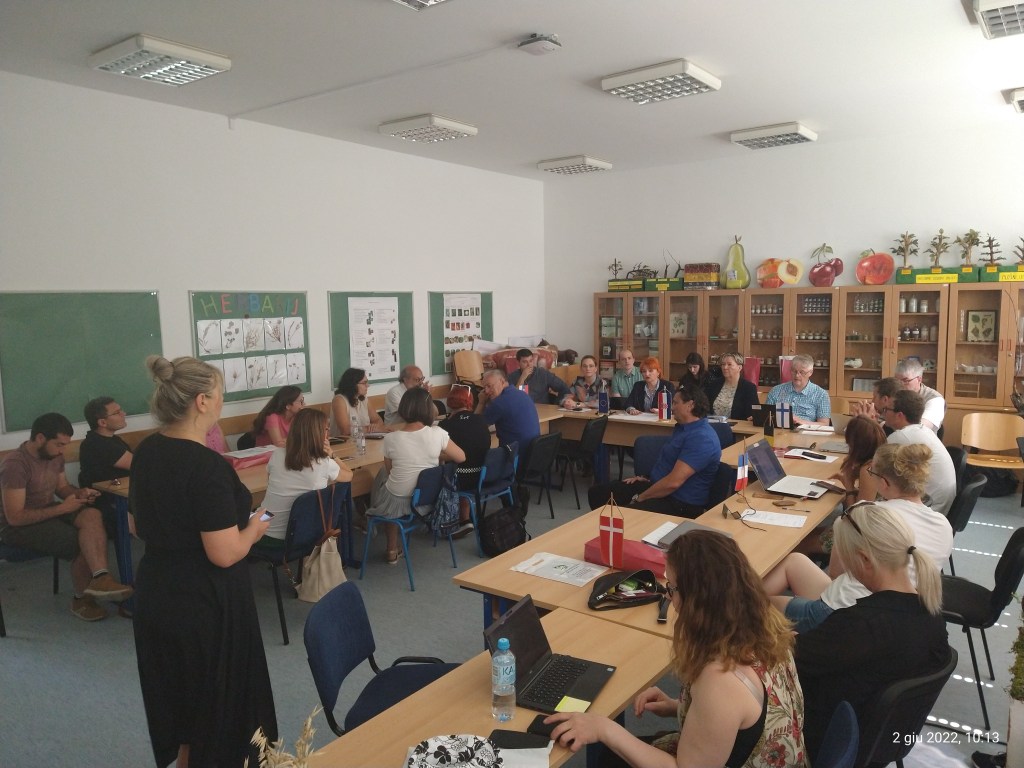
The LTTA ended on Friday, 3rd June, with a wrap-up meeting at the school. Also, the representative of Lapland University outlined the programme for the following transnational project meeting. The partners agreed on a common agenda and work to be performed before that meeting.
The Learning Activity was attended by 27 participants, gathering university professors and high school teachers, educators, and representatives of different organisations from the eight countries involved in the project: Italy, Denmark, Finland, Belgium, France, Spain, Croatia, and Serbia.
 FARMER