
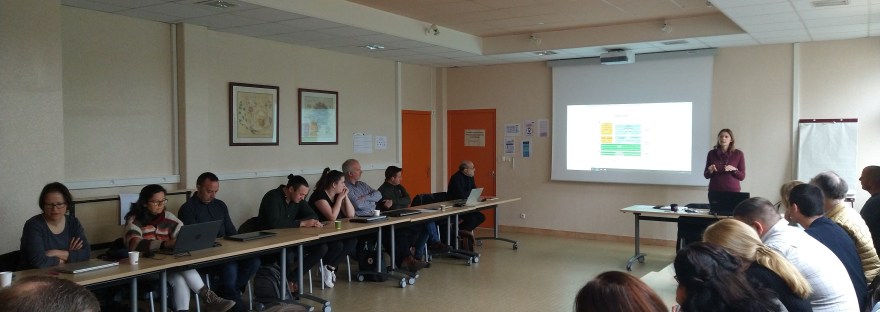
Perigueux (France), 27 – 30 March 2023
“Today, a young farmer must constantly adapt to overcome the difficulties: the market changes, the climatic hazards, the digital transformation. They must adopt an entrepreneurial vision to ensure the viability of agriculture”
From Monday 27th to Thursday 30th March 2023, the project partners met in Perigueux (France) for the third Learning, Training, and Teaching Activities (LLTA), hosted by the Vocational Agricultural School of Perigord.
Many sessions were held jointly with students from the Lycée Agricole de Dordogne (Agricultural School of Dordogne), an essential contact that allows students to enter into the debate with the project partners to assess the expectations of future practitioners of farming.
The LTTA started on Monday 27th with a meeting at the Vocational Agricultural School of Perigord, where the partnership was introduced to the French Educational System and School specificity by MECHAUSSIE Virginie and Patrice POURCEL. Following, she gave a presentation on the importance of agroecology and the role of schools in preparing students and acting as models for experimentation and innovation.
In the afternoon, the partners learned the Certificate of Specialisation in “Agricultural Methanisation Unit Manager” (CS RUMA), thanks to a presentation done by Carine DUMA-LARFEIL. The Certificate was created by the Ministry of Agriculture and Food in 2019 in response to the sector’s professionalisation challenges. The first day ended with a guided tour of the school’s farms and Perigueux’s historic centre accompanied by the students.
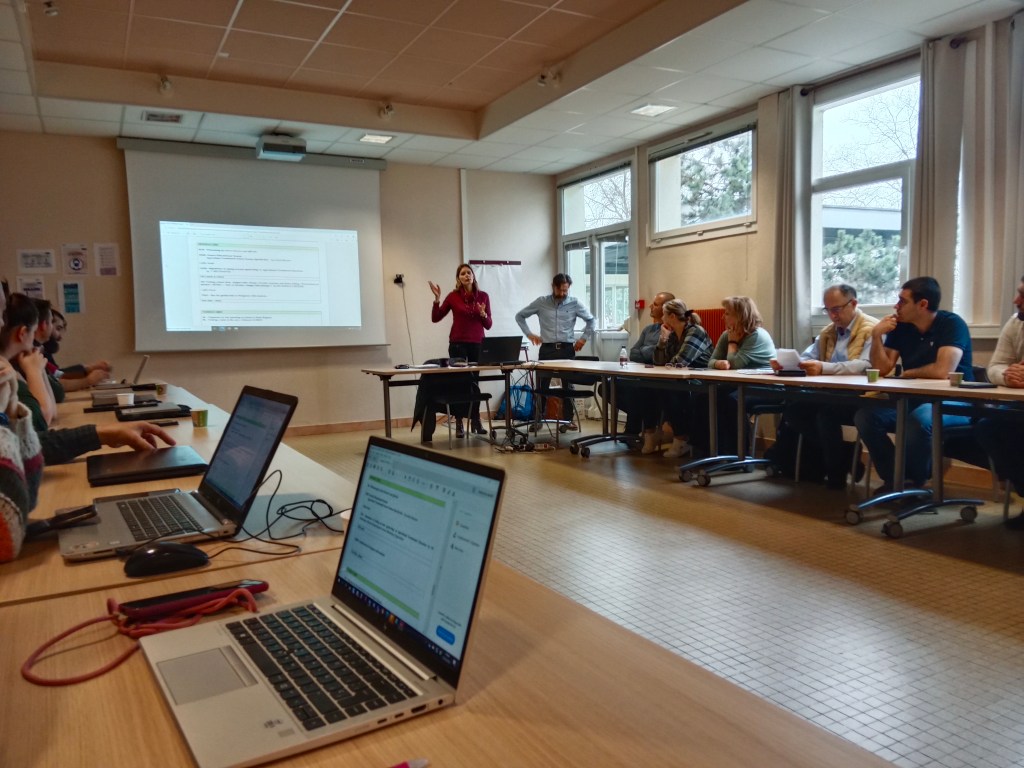
On Tuesday 28th, the agenda started with the visit to Clément Guerin’s farm. There, the partners explored the opportunity offered by biomass as a complementary income and environmentally friendly energy source.
In the afternoon, they participated in a co-teaching class on the theme of agroecology. During the class, local students of CGEA and international professors worked together on “Agro Challenges”, a serious card game that allows students to learn about the agroecology concept for solving agricultural challenges and problems, integrating different approaches (agronomical, environmental, economic, social…) at various scales (local and global). This workshop was handled by the crop production and the English teachers.
The second day ended with a presentation of the reformed climate risks insurance system by Agnes TESNIERE, responsible for insurance at Credit Agricole Charente Perigord.
On Wednesday 29th, the partners visited the school’s farm, guided by the ACSE students, to exchange the methods and challenges in breeding limousine herds and cultivating truffles. The morning continued with an animated discussion with students about which skills would be needed for future farmers.
In the afternoon, partners met with Marie Laure LE GOFF to address the question of access to land, particularly by those who would like to start an agricultural activity. To provide alternatives to the need to acquire agricultural land, new forms of support are emerging, the “Espaces test“. Those are a form of farm incubator which allows future farmers to access public land to test their idea while receiving tailored technical, legal, and accounting support.
The third working day ended with the presentation of VITEA project by Jean Marc BAYLE, and Erasmus+ good practice led by the Vocational Agricultural School of Perigord. The project gathered European service providers in vine pruning, VET organisations, and a regional certificate institution from 8 wine-growing European countries to improve vine pruners’ competencies and ensure better employment and income.

The last day, Thursday 30th, started with two school students presenting a project on food production they implemented in Perigueux. Later, the partners debated in smaller round tables about different national approaches to teaching, accessing land, and new agricultural practices. Each participant was thus able to gauge his own state of functioning and assess his own degree of advancement and the prospects for possible progress.
In the afternoon, the consortium held a management meeting to evaluate the project’s progress, communication and dissemination plan, and the next steps: an online project meeting in June and the following LTTA in Spain (November 2023) and Serbia (2024).
The LTTA ended with the presentation of the association of Young Farmers, Jeunes Agriculteurs Dordogne, by Servaes VERSLUIS. That is an independent union dedicated to the cause of young farmers in France, active at national, regional (14), and departmental (95) levels.

The Learning Activity was attended by 34 participants, among university and high school professors, educators, and organisation representatives from the eight countries involved in the project: Italy, Denmark, Finland, Belgium, France, Spain, Croatia, and Serbia.
 FARMER